Top Ten Animated Films with Guest Writer Tucker Meijer: #9 Critics' Take
Here are Tucker’s take on my choice, The Wind Rises, and my take on his choice, Nausicaa: Valley of the Wind. Below is our original posts.
Tucker’s take on Jeremy’s #9: The Wind Rises
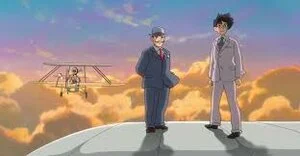
I feel like Jeremy’s back-to-back picks actually work as great companion pieces to each other; like The Iron Giant, Hayao Miyazaki’s The Wind Rises deals with humanity’s interaction with machinery. But where the focus of The Iron Giant is on the “created,” The Wind Rises is a deep dive into the mind of the “creator.” As Jeremy rightfully points out in his review, this manifests in Jiro’s artistic process and the way that he actually sees his creations in action before he writes them down on paper.
The juxtaposition of Jiro’s imagination (often featuring vibrantly colored grass that ripples in the wind and a bright blue sky dotted with majestic clouds) and his place of work (a crowded room with other engineers) turns the film into an experience that is both incredibly grand in scope and intensely intimate. The audience is treated to Jiro’s creative process but often that process manifests in a cinematic way. This is one of Miyazaki’s talents and one that he does particularly well in this film: the grand scope never overwhelms the intimate character studies in the film.
As Jeremy notes, The Wind Rises is set in our world and lacks the same kind of magic that is so central to Miyazaki’s other films. But even so, Jiro’s vivid imaginations do have a kind of fantastical quality. They are beautiful, but they also mark important moments in Jiro’s thinking and character development. Through this, the film, which at times feels brutally real, is lightened by these vivid and fantastical imaginations.
The relationship between Jiro and Naoko is one of the elements of the film where Miyazaki showcases his pacing ability. The relationship unfurls slowly, with Jiro and Naoko serendipitously meeting on a train. From their first meeting, you can tell that it’s love, but it takes them a while to cross paths again. When they do finally get together, their relationship is one of mutual respect and love; Naoko allows Jiro to explore his passions through his work and Jiro supports and cares for Naoko during the course of her sickness.
Naoko’s sacrifice to leave Jiro is heartbreaking but it’s also an encapsulation of why their relationship is so beautiful; she so intimately understands Jiro and his need to create that she allows him to flourish in that. Jiro’s final dream, when she appears one last time to tell him to live his life to the fullest, is the best conclusion to their story. Naoko loves Jiro so fully and unconditionally that she tells him to move on and live his life.
As Jeremy mentions in his review, writing takes time and Miyazaki does a wonderful job of exploring this through Jiro’s creative process. The respect that Miyazaki has for this process, allowing it to occur on its on time, extends to the pace of the film in general. It is long, but not overly so, which gives the audience an intimate look at Jiro’s life; each moment seems significant and expertly planned.
One of the things that I love the most about Studio Ghibli films (but especially with this one) is just how aesthetically beautiful they are. As I mentioned earlier, Jiro’s imagination of a wide-open field with planes dipping out of the sky is just so wonderful to look at. There are other shots in the movie that have a similar awe-inspiring syle: when Jiro sees a flaming plane plunge into the snow from the sky, when an earthquake turns the ground into an ocean with waves, when Naoko and Jiro stand together at a pond. These are just a few moments in the film that are just spectacular.
I love that Jeremy and I both went with different Miyazaki movies for this week. A true testament to his legacy and craftsmanship as a filmmaker.
Jeremy’s Take on Tucker’s #9: Nausicaa: Valley of the Wind
Tucker is right. Nausicaa: Valley of the Wind is indeed a film for our times. A warning against destroying nature, depicting a world where after humanity destroyed the world, nature decided to fight back, creating the Toxic jungle on the surface of the world where insects reign supreme, while humanity is forced into the sky to live on floating islands. With environmental calamities increasing due to global climate change, this film’s warning of our actions seem extremely relevant and important.
[On a sidenote: a new animated masterpiece has been released on Netflix in the form of a “TV show” and a prequel to the great film, The Dark Crystal. The Dark Crystal: Age of Resistance explains how the planet Thra fell into such ruin that we know from the film. The evil Skeksis were once believed to be protectors of the great Crystal, life force of Thra, which they harvest the planet’s life force in order that they might live forever. The problem is that their process has corrupted the Crystal and now the darkening has begun: a planetary scale destruction of all life. Nature itself is going insane and being destroyed. To block anyone from finding out the truth about their goals, the Skeksis engage in a misinformation campaign to distort the truth. Sound familiar?]
Back to Nausicaa: Miyazaki has long been a champion of the environment without being a doomsayer. His lifelong ambition has been to seek balance, not dominance. Hence his movies rarely contain a true villain. Indeed, in Nausicaa, it is humanity's ignorance and fear that are the main enemy, not an individual villain. Nausicaa, a young princess, must convince not only her government, but all humans that the Ohms, Giant armored insects with multiple red eyes who scared the hell out of me when I was young and saw this film for the first time, who they blame for poisoning the earth, are not their enemies. The ending scene that Tucker so beautifully talks about in his review, indeed shows the coming together of two races who do not understand each other, letting go of their fear, and embracing each other.
Nausicaa is one of Miyazaki’s earliest works, and yet, it contains almost every element that he would use in his future films: From a fantastical environment, uniquely created out of his imagination, to his anti-war views that are contained in so many of his films. The pointless fighting in Nausicaa only leads to humanity inching closer to their own destruction, even though, the war is not the point of the movie, merely the backdrop on which this story hangs.
It also has a female protagonist, which is a Miyazaki staple. So many of his films involve young, brave girls who must go against societal beliefs. Whether it’s Kiki, or San, or Princess Mononoke, or Nausicaa, his heroines are meant as a rebuke to Japanese patriarchal culture. And then finally, there is his environmentalism. Miyazaki doesn’t believe technology is bad. Even in his old age, he finally embraced using computers to animate his hand drawn images or even create an image or two. Instead, he believes in harmony and balance. It’s not as if he is saying that humans should destroy the Toxic jungle and retake the Earth, but rather, through working with the other life on Earth, they might find a peaceful resolution.
I think that Nausicaa does at times suffer from such a complicated world that we truly don’t always understand exactly what is going on in terms of the geo-political struggle. Because it is one of his first films, themes that Miyazaki returns to become both clearer and more complex in future films. There are also sections of the movie that slow to a snail’s pace without much reward, but for a master who was working on his first solo and original feature, it demonstrates an artist at the pose of a great career.
Tucker’s #9: Nausicaa: Valley of the Wind
As I write this, the Category 5 Hurricane Dorian is hurtling towards North America, about to make landfall. Last year, while I was at school, my home state of California was engulfed in flames from both the north and the south and a thick blanket of smoke covered the Bay Area. Every day, there is a new catastrophe related to our quickly warming Earth as our constant desire to develop the land has finally caught up to us. Of course, solutions don’t come easy; geopolitical squabbles and party alliances drive wedges between any kinds of progress.
The intricately built world of Hayao Miyazaki’s Nausicaä of the Valley of the Wind does not seem so distant anymore. In the film, one thousand years have passed since the Seven Days of Fire, an apocalyptic war that destroyed all civilization. Not only has the human folly of the war leveled cities, it has also created a poisonous forest swarming with mutant insects called the Toxic Jungle.
Just like our world, human intervention has had a profound impact on the environment. While there may not be a fully Toxic Jungle (there is more than enough evidence to suggest that Toxic Oceans exist, however), humans have undeniably negatively affected our world. But there are people, some of them as young as 16, who are trying to combat this.
I provide this connection to our world for a few reasons. The first reason is to underscore the urgency of a film like Nausicaä of the Valley of the Wind, which was released in Japan in 1984. Couched within this urgency is the fact that, through the real-world connection, Nausicaä is an ultimately hopeful story about how humans and the environment can coexist.
This hope begins with the protagonist, Nausicaä, who is the princess in the verdant Valley of the Wind. Nausicaä is headstrong, clever, and optimistic that there is a way for humans and the mutant insects to live together in harmony. She is a scientist who has her own lab where she cultivates plants. In essence, Nausicaä is the perfect person to combat the environmental catastrophe. Her gender is not insignificant; Nausicaä is a princess, but she is also someone who can fight and think with incredible alacrity.
Nausicaä is also a testament to Miyazaki’s ability to create such a fully realized world, one that is colored by geopolitical struggles. This does not mire down the narrative; rather, the story of the warring kingdoms of Tolmekia and Pejite raises the stakes and suggests that in this world, no one is spared.
Like Miyazaki’s other films, Nausicaä of the Valley of the Wind is full of his trademark magic and creativity. There is richness to the narrative and characters that feels authentic, adding an emotional heft to the big moments in the film. Nausicaä is actually not a Studio Ghibli film (it was released before Studio Ghibli was founded) but it still fits nicely into the Ghibli collection.
As I’ve mentioned, Nausicaä is a narratively wonderful film. But it is also beautifully animated. There is a shot near the end of the film where Nausicaä is resuscitated by some of the giant insects, known as Ohms. The Ohms, their tentacles glowing golden, surround Nausicaä and she is revived. Her dress is drenched blue with Ohm blood and the colors are vibrant and vivid. It’s an incredible moment. It’s narratively grandiose of course, but more than that, it is a moment that feels intimate, despite its enormity. The Ohms treat Nausicaä with tenderness and gentleness and it’s difficult for me to watch the sequence without tearing up.
It’s also a sequence that hammers home the point of the movie: that humans and the natural world can coexist, if people are willing to put aside their differences and work together to make it happen. Nausicaä is the shining example of how age does not have to be a limiting factor when it comes to the Earth we live upon.
In a time when the status of the climate seems incredibly bleak, I watch a film like Nausicaä of the Valley of the Wind and I am filled with hope.
Jeremy’s #9: The Wind Rises
In 2013, Hayao Miyazaki, who has earned the nickname “the god of animation,'' announced he was retiring and making one final film. In 2019, there’s the possibility that Miyazaki may be coming out of retirement to direct again; he just can’t be kept away. But, even with that announcement, there’s a good probability that we may never see another film animated by Hayao Miyazaki. One of his concerns that prompted his retirement is that his handshakes, making drawing nearly impossible. Here is an artist who drew 144,000 cels in Princess Mononoke and now cannot animate his own films. Whatever happens in his career in the future, Studio Ghibli marketed The Wind Rises as Miyazaki’s “Farewell Masterpiece”. It may not be his “Farewell” film, but it is indeed one of his masterpieces.
One of Hayao’s obsessions throughout his career is flight. Obviously, flying is a liberating feeling, but for Miyazaki, it’s more than that. It creates meaning. The ability to soar, whether in our imagination, or our creativity, or physically, allows us to leave the mundane ground of our pointless lives and find an abstract, but powerful meaning. The best illustration of his belief is his “Farewell Masterpiece” The Wind Rises.
The Wind Rises begins with Jiro Horikoshi as a school age-child, but he is not in school. He is in a plane, flying high above the Japanese countryside. The plane has wings with what looks like feathers, visually connecting him to the birds he shares the air with. It is only then that Jiro wakes up from his daydream. He’s actually in school. Already, he is different than his peers. He has thick glasses, and like so many who are different, seems to be a target for his peers. Because of his differences from his peers, his teacher has taken a liking to him. He steps outside of class to give Jiro a magazine with designs of Giovanni Battista Caproni’s new planes. This Italian engineer is Jiro’s mentor in his dreams. One day, he hopes to meet him in reality. This love of planes sets in motion the life of an engineer with a desire to create airplanes of beauty that allow us to soar above the clouds.
Miyazaki wisely sets this story about imagination and creativity of an engineer against a love story. On his way to his first job after school, Jiro sits on the steps of an overcrowded train when the wind grabs his hat and takes it off his head. Trying to grab it, he almost falls off the train. The hat is caught by a teenage girl, Naoko, who is traveling with her mother. The two share an incredible moment as she places the hat back on his head. Years later, while she is recovering from an illness, they will meet again. Just like in Romeo and Juliet, she will stand high above him on a balcony, like the clouds he seeks to reach. Shooting a paper airplane up to her, she grabs it, but drops her hat. Running after it, he crashes into the nearby trees, but successfully retrieves her hat, returning the favor. These two are meant for each other.
Unlike most of Miyazaki’s other works, there are no fantastical elements to The Wind Rises. Being his first film set completely in our world and containing historical references and characters, Miyazaki does something that is common in Japan, but not common in American animation: he makes an animated film purposefully not for children. This film is a drama just like any other live action drama. The Wind Rises has two amazing elements to it. First, it is the best film I have ever seen to tackle the concept of how creativity and inspiration work within an “artist”. And, second, it is also one of the best cinematic romances ever told.
In too many works about artists or creators, creativity and inspiration are treated as flashes of lightning that connect immediately to the creative final product. Take JM Barrie’s journey in Finding Neverland. While meeting the family who would become the inspiration for the Darlings, JM witnesses the strict grandmother, a completely underused Julie Christie, berating her grandchildren while holding a coat hanger in her hand. Oh, I see! That’s how JM Barrie came up with Captain Hook! Inspiration does not work that way. As a writer myself, writing takes time. Inspiration comes more often during the act of creation, not before. Jiro, in The Wind Rises, is inspired by nature. He is observational, but those observations take a long time to inspire work. Yes, he sees how a fish bone bends while eating lunch one day, but it takes him years to implement the idea of a more flexible frame in a plane. Watching Jiro struggle with his design and attempt solution after solution only to fail again and again is ultimately inspiring. He seeks help, traveling to Germany and Italy. He dreams. He observes. It is only slowly through reflection and work that it comes together into his beautiful creation of a seamless airplane.
The love story between Jiro and Honjo also takes it time. It allows the characters to develop genuine feelings for each other. Jiro could have devoted himself solely to his career. He is obsessed enough with it, but Miyazaki takes time to connect their romantic relationship to flight as well. Meeting each other when Jiro’s hat flies off his head, and reconnecting together later, their connection is constantly a reminder that their love allows them to fly as well. In Shintoism, water is considered a healing power and throughout Miyazaki’s works, he plays with this image as well. Yes, Naoko is dying, but her love heals Jiro, allowing him to create his dream, while he heals her to allow her to live a life despite her illness. The images of the two of them exploring a Shinto pond, or of walking together while being caught in a storm, remind us indeed of love’s power to heal and allow us to soar. Naoko’s ultimate sacrifice is one of love that Jiro understands completely. She allows him in her love to finish his other dream so he can take to the sky physically, just as he has done spiritually with their love, and creatively in his imagination.
Before its release, The Wind Rises unfortunately garnered some controversy especially in America. Jiro is the engineer who designed the Zero airplane used by Japan to bomb Pearl Harbor. My father is an immense fan of Miyazaki’s. He originally introduced me to his films with My Neighbor Totoro and Nausicaa: Valley of the Wind when I was a child. But my father also grew up in Hawaii. He refused to see this film. For some, the notion of a film being made about the Zero airplane without dealing with its destructive use in WWII is not acceptable. I think that Miyazaki deals with the ideal of the creator of the airplane trying to create something for peaceful purposes that unfortunately would be used for war. When Jiro cannot figure out how to make the plane light enough, he suggests getting rid of the weapons on board. His ideals are indeed taking flight, but the world around him is at war. The unfortunate consequences of his creation are better suited for a film that deals with them rather than this one that sees his creation as a symbol.
When The Wind Rises came out, my film students went to see the movie. They cried during it. An animated film that can make teenage boys cry… that’s doing something magical.