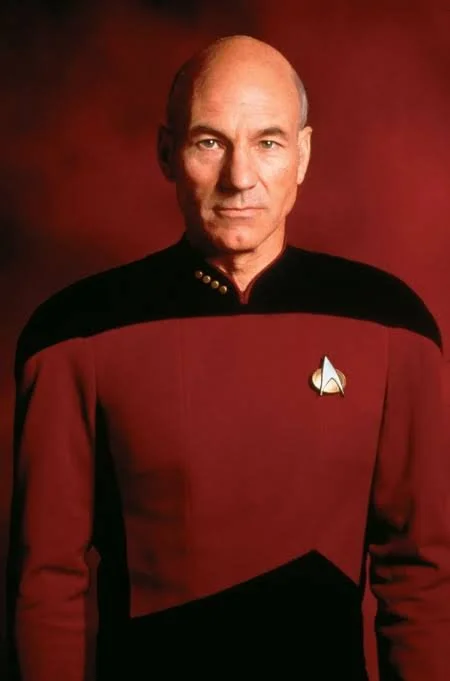
To my hero... Rest in Peace Patrick Stewart
Patrick Stewart was of course larger than his role in Star Trek. He will be remembered as one of the heralds of the stage, a brilliant Shakespearean actor, an advocate for social causes such as Amnesty International, a great friend, and a good man. I had the pleasure of seeing him in three live shows over the years: Pinter’s The Caretaker and No Man’s Land, and Beckett’s Waiting for Godot. In all three, he commanded the stage and completely disappeared into his character. The one thing all of his characters shared whether a pompous nobleman in No Man’s Land or a thief in The Caretaker was his voice which commanded attention and respect. I loved him as other famous roles such as Professor X, who has been said is my superhero alternate persona, and who was never better than in the great film Logan. But, for me, Patrick Stewart will always be Captain Jean Luc Picard because Captain Picard was my hero, my role model, and my friend.
Growing up as the son of an interracial couple, my parents introduced me to their favorite show Star Trek at a young age. My parents also loved other shows, my father Columbo who I think he saw some of himself in. My mother both M*A*S*H for its social justice themes and Cagney and Lacy for its strong female leads. But, Star Trek was much more than mere entertainment to my parents. It was, as Rene Auberjonois, the actor who portrayed Odo, said, “the most positive vision of humanity since the Kingdom of God.” Here was a show that envisioned a future where humanity had grown out of its infancy. Where greed, racism, hunger, and inequality were all things of the past. The crew who populated the bridge of the starship Enterprise represented different ethnicities and genders, treated as equals, and always working together. For my parents, an interracial couple in the Midwest in the 1960s and 1970s, the show offered hope when dealing with the racism they faced, not only from society, but also their own families. Growing up, every Wednesday night was family night. We would get takeout food and watch reruns of Star Trek as a family. I identified with Spock, who himself was mixed race. I also loved Sulu, one of the few positive Asian characters I ever saw. But I never really loved Captain Kirk. He was of course heroic… but carried that traditional heroism almost to a fault. I loved him when he would sacrifice himself like he did to save Spock in “Amok Time”, but too often, he was not far from the spoofs that would follow: a ladies’ man who fought his way out of danger. Never having been a traditionally masculine man, I never identified with Kirk. I felt, like Sulu, I would also be a minor character in my own story. Kirk would grow more as a character in the films than he ever did in the TV show.
When I was four years old, Star Trek: The Next Generation began its run. I don’t blame my father but after watching about half of the disastrous first season, he quit the show. My mom and I hung in there and continued watching. I liked the original Star Trek and would appreciate it more as I grew and rewatched the show I barely remembered as a child. But, it was The Next Generation where I found my hero and the man who I would want to emulate.
Knowing that Next Generation could not simply repeat the original show, especially as there would be a movie with the original cast debuting while Next Generation was on TV, the creators purposefully wanted a Captain different from Kirk. They could not have done better than Jean Luc Picard portrayed by Patrick Stewart. Like Kirk, Picard could be an excellent military leader and fighter if need be. In “Yesterday’s Enterprise”, Picard commands the Enterprise during the battle against three Klingon ships to save another starship named Enterprise. When an explosion on the bridge kills Commander Riker, the Klingon assailants tell the Enterprise to surrender and prepare to be boarded. Picard declares “that will be the day” before jumping over the tactical station and continuing the battle. He has never been more traditionally heroic. In “Darmok”, the Next Generation flipped the original series episode Arena where rather than battling each other, Captain Picard and Captain Dathon, a Tamarian, battle the “beast of Tanagra” together, forging a bond. Rather than the fight itself being the most meaningful moment of the episode, it is Picard discovering that the Tamarians speak in metaphor that is most memorable moment; imagery and story being central to the Tamarian understanding of the world. As Captain Dathon is dying, he asks Picard to share a story. Picard ironically says he’s not much of a storyteller, given that Patrick Stewart was one of the great storytellers of our age. But this does not deter Captain Dathon who continues his request. Captain Picard shares the ancient story of Gilgamesh and Enkidu, one of the root metaphors of the Western world, who start as enemies and become great friends. Recounting when Gilgamesh loses Enkidu, Picard recites the epic poem, saying, “he who was my companion, through adventure and hardship, is gone forever.” I feel the same way…
Although Kirk could conduct important matters of diplomacy, Picard’s primary quality as a leader is that he was a diplomat. In “Redemption” Part I, a dying Chancellor of the Klingon Empire selects Picard to be the arbiter of his succession. Picard refuses citing the Prime Directive, but the Chancellor insists “you are an accomplished diplomat. This is no different.” Reluctantly Picard agrees. He puts aside his own feelings of who should lead the Empire or consideration of how this selection would effect the Federation and acts as a mediator. He ability to respect and understand both sides is such a strength, but he also knew when to take a stand. In “The Ensigns of Command”, it is discovered that a group of humans are surviving on a planet promised to the Sheliak in a treaty, because the Sheliak consider humans inferior, they demanded that the treaty be written with such specificity that is thousands of pages long. At first, the Sheliak use the treaty as a cudgel to get what they want, but Picard, using his intellect, discovers his own loophole and exploits it. Not for revenge or out of spite, but to get the three weeks he needs to evacuate the humans from the Sheliak world rather than letting the Sheliak remove them by force. Kirk would have attacked the Sheliak… we all know it. I have long believed that violence is not an effective instrument and that the goal of bringing two people together who disagree should be the way to resolve conflict. Seeing such a capable leader who lived these ideals and earned the trust and admiration of those around him continues to inspire me.
Despite Picard being a distant leader, who felt that to remain objective, he needed to maintain a healthy boundaries from his crew, he could in fact be injured and even at times show genuine pain. Kirk could be physically hurt, but at the beginning of each next episode, regardless of what happened, he returned to his perfect self. In “The Best of Both Worlds”, Picard experiences the greatest trauma of his life, being kidnapped and assimilated by the Borg. The second episode of season four, “Family,” sends Jean Luc back to his childhood home to see his older brother. Here, he breaks down crying, explaining to his brother his own guilt, not only for the atrocities that he committed as Locutus, a Borg, but also, his guilt for “not being strong enough.” Stewart delivers these moments with such genuine pathos. In a society that teaches us not to show weakness and that tears are not masculine, Picard gave me permission to express my own pain.
Another way that Picard was the anti-Kirk was in his intellectualism. Kirk was intelligent, well read, understood history, but Picard relishes history with the enthusiasm of a child in a candy store. In one of the funniest episodes, “Q-Pid,” where Q transports Picard to Sherwood forest and turns the crew into Robin Hood and his merry men, the episode begins with Picard worried about a speech about archeology he is about to deliver. Throughout the series, Picard’s excitement over academics made him a standout in a traditional masculine role. He made it okay to be nerdy. Hell, he even made it sexy to be nerdy at times. For myself, who was never the star athlete, and always felt judged and belittled for my intellectual identity, he gave me permission to love myself for who I am.
As a result of the occasional longer narrative elements of the series, Picard, unlike Kirk, was allowed to grow and change as a person. Perhaps this is never better expressed than the final image of the last episode “All Good Things.” In “Lessons,” Picard falls in love with one of his officers and during a mission is forced through circumstances to order her to remain at her at her post even though it would probably mean her death. This is why Picard has always felt the need to maintain a distance from those who serve under him. Yet, despite that distance, it was always apparent of the care he had for every member of his crew. In “Lower Decks”, Picard orders a young Ensign on a mission that takes her life. When he informs the crew of her loss, he does so with the strength expected in a leader, but also with an undercurrent of his own sense of loss. Patrick Stewart being one of the most gifted actors of our time, could play both emotions at once. Showing Picard as the constant professional but also revealing the man underneath. In “All Good Things”, Picard finally allows this barrier between him and his crew to drop. In the final moments of the show, Picard joins the crew to play poker and says, “I should have done this a long time ago.” The comradery and family of the crew of the Enterprise would pay off in the best episode of the Picard series, “Nepenthe” when Picard in a time of need goes to Riker and Troi who greet him, not as their former Captain, but a long-time friend. This family was not just an element of the script, but rather the friendships and bond the cast and crew created throughout the seven years of filming. That bond is felt in every moment of the show.
Just as the bond between the cast and crew gave the audience an insight into the actors playing the characters, so too did each actor infuse their character with themselves. Patrick Stewart, long an advocate for social justice, had done a lot of work with Amnesty International. When called upon to play Picard enduring torture, Stewart felt a responsibility to accurately portray that reality of victims and survivors of torture. He interviewed survivors and spoke with how to correctly portray the reality of the scene. It is perhaps Stewart’s finest hour of playing Picard in “The Chain of Command” Part I and II. The vulnerability shown is a lesson in a society that does not value such expressions.
Like so many Star Trek actors, or actors associated with a specific character like Sir Alec Guinness was with Ben Kenobi from Star Wars, Stewart did seem to feel a desire to distance himself from Star Trek following the final Next Generation film, Nemesis. But, he came back to play Picard in another Star Trek series. While the show Picard never reached the height of The Next Generation, seeing Patrick Stewart inhabit Jean Luc Picard again felt like meeting an old friend again. I understand Patrick’s desire to be remembered for more than Picard. He was one of the greatest actors of our time. His best friend Ian McKellen said to him when he was offered the role of Picard that he needed to reject it for the sake of his theater career. If he had, the world still would have gotten Stewart’s Macbeth or his one man Christmas Carol and so many great performances, but I would not have met my hero. A man who changed my life. Patick Stewart’s Picard crystalized the type of man I wanted to be: diplomatic, empathetic, expressive, genuine to my own feelings, accepting of my own nerdiness, willingness to change and grow. I try to live up to these ideals.
One of my most cherished memories was meeting and having a drink with Patrick Stewart after a premiere. He was meeting others at the bar, but I walked with him. He ordered a glass of Knockado and I followed suit. He then offered a toast, “To the dream, may it live on in us.”
Patrick because of you the dream will live on in me and all I encounter… for you were responsible for the man that I am.