Forgotten Island *** 1/2
I don’t often begin a review with a disclaimer… but… Ethan Tanti, the assistant to the producer and directors of Forgotten Island, is one of my former students. First, I wanted to start with that information because I am so proud of Ethan, but also, Ethan said he wanted my unvarnished review. So, I promised him I wouldn’t let our friendship color my opinion of the film and issue a disclaimer. While I am overjoyed and happy to share the experience of watching the film with his family and friends, it does not affect my review.
In this time of sequels, remakes, and adaptations, Forgotten Island is an original gem of a film about the enduring friendship of two Filipino girls. It is so rare to have a film starring two young women especially when the film purposefully lacks any romantic interest for either character. The film passes the Bechdel test without even breaking a sweat. Because an original story like this is so rare, it felt like a breath of fresh air even before the story began to unfold.
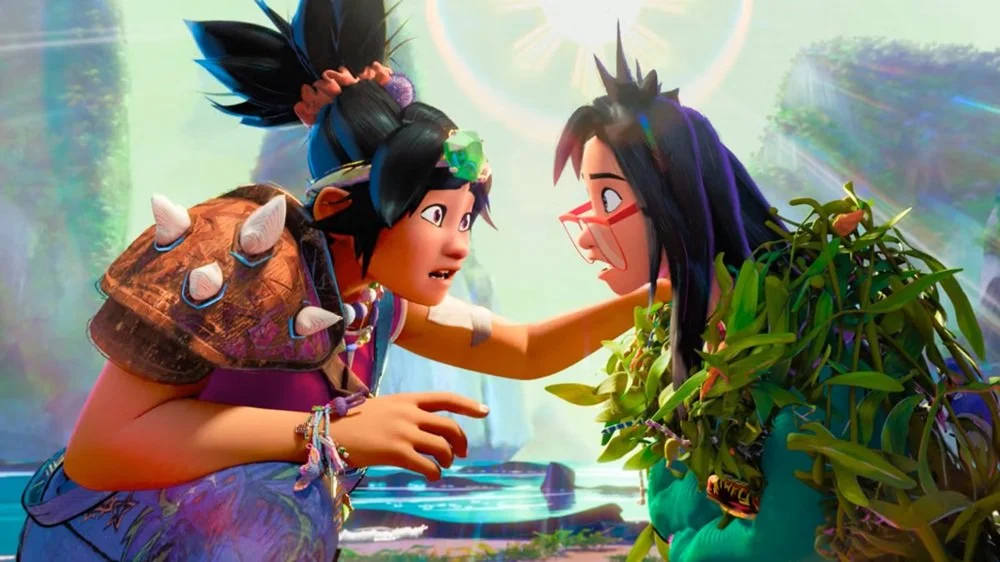
Forgotten Island wisely grounds itself in its characters. The first ten minutes involve a series of sequences where our main characters, Jo (misfit, who is new to school and raised by her incredible grandma, Lola) and Raissa (science nerd) meet and become best friends. Their first encounter sitting outside the principal’s office uses its visuals so well. Raissa, not used to waiting for the principal, is stiffed back, nervous, looking down. On the other hand, Jo has been expelled from school before and lounges on two chairs. How she moves, slinking and sliding from one chair to another, shows so much about her character. What proceeds is a sequence of memories much like the opening of Up where we gain an understanding of a lived life. One of the great visuals of their friendship is their friendship bracelet that they add charms to throughout their adventures. That the bracelet plays such a profound role in the story itself is smart writing. However, as time passes, eventually their differences begin to pull them apart.
Like the two best friends in Ghostworld (another movie about the relationship between two young women, although there is a “love interest” in that film), one of them is “going no where” (Jo, in this case) who at one point proudly expresses that she has become the face of the third most popular fast-food chain. Then, there is Raissa whose scientific skills have garnered the attention of Cal-Tech in America. Trying to navigate how to say goodbye but also hold on to their friendship leaves them unable to speak their truth to each other for the first time in their relationship. Then, everything changes.
I am going to avoid spoilers for the first part of this review but then will get into specifics in the end. I will issue a warning when that begins. Lola, Jo’s grandmother, has always claimed that she has journeyed to Nakali, a Filipino mythical island, home to legions of magical creatures. Like Miyazaki (could I issue higher praise?), the film’s fantasy world, while original, feels wholly integrated into culture. It’s remarkable how otherworldly and yet true Nakali feels. Although the audience knows that their friendship will be tested, and the moment of that test feels somewhat manufactured by the script, it still works emotionally like the best Pixar films because the film has taken its time to create a believable friendship.
The directors previously made the fantastic Puss and Boots: The Last Wish, which combined multiple forms of animation in inventive and successful ways like Spider-man: Into the Spider-verse. Here, they combine anime with a combination of more traditionally looking animation and more stylized, but I don’t feel it is as effective as Puss and Boots. Rather than being woven into the fabric of the story, it adds a sense of style, making the film feel more authentically Asian in a good way, but not in a profound way.
If I was forced to describe the movie… I would say Forgotten Island is – Pixar like (emotional character driven storytelling) combined with a Miyazki like fantasy (profound imagination that gives a sense of reality to the film) with anime (at times episodic and also incorporating the style) and pop culture and music. It’s a wild original ride worthy of seeing more than once.
And now come the spoilers! So instead of reading more, go see the movie! Then come back and finish.
It will surprise no one that the at first helpful, Batiba, whose features invoke the Cheshire cat from Alice in Wonderland, is indeed the villain of the film. A memory demon who trades people’s memories for a chance to return home. There is also more than a little Ursula in this character with her branches acting like Ursula’s tentacles and her nature being a tempter. Her underground lair, like Ursula’s, is where people surrender who they are for her aid. Batiba is a good enough, if obvious, villain, but my main issue with the film lies in the rules of Nakali and how Batiba’s memory spells work.
The structure of the story is that after arriving on the Island at 7pm, our main characters wake up at 7am, having physically changed (Raissa is half bald) and realizing that they have no memory of the past twelve hours. This mystery provides the structure of the film as they journey across Nakali connecting with people they met, trying to remember what happened. Sometimes what actually happened versus what they think happened is conveniently withheld or warped. Even with those slight annoyances, the film does a great job with so many set-ups and pay-offs, like Jo originally offering Batiba her shoe as a memory and in the end, her shoe being the gift she gives her to help Batiba take her first steps. But there is a lack of knowledge from the audience about how Batiba’s magic works. After Jo sacrifices herself to free her best friend Raissa, Raissa is sent back to our world while Jo remains in Nakali, her memories being taken by Batiba, part of her fair bargain (Ursula influences are pronounced). Raissa magically connects their bracelets accidentally and creates a portal into Nakali. It is truly convenient and not really explained. Imagine if there had been rumors about people arriving in Nakali to try and reclaim their memories without Batiba’s aid. This could have been set up and explained. Similarly, Raissa seems to know she can save Jo’s memories by entering them as they are being drained and talking to Jo in the memory. I don’t know how she knew this, nor did I know what she hoped to achieve while in those memories. The lack of understanding digs in the back of your mind while watching, because the movie is moving at such a great speed and you care about the characters that it may never rise to the front of your thoughts. I wish I understood her plan and how it was going to work.
While the climax between the main characters is great (realizing the importance of their friendship and that Jo is not a rock to sink Raissa), the resolution to the supposed villain of the story feels hollow. The movie begins with Jo, a new student in school, giving a family presentation on Manang, a vampire like demon who lives in Nakali. Later when Jo and Raissa arrive in Nakali, they steal Manang’s wings. The great visual metaphor provided by Raissa’s mother to try and separate Jo and her daughter is that Jo is a boulder and Raissa is a rocket. The wings allow Raissa to soar. Jo is stuck on the ground. Because of her wings being taken, Manang hunts our heroes throughout the movie. She is the supposed villain coming after them, but it is revealed that Batiba stole her memories as well. In the end, Manang receives her missing memories, but we never find out what they are. I thought where the creators were going was to make it that Manang is Lola’s lost friend who sacrificed herself and her memories to get Lola home after visiting Nakali. It would have been a meaningful connection paying off setups throughout the film.
But these complaints are minor. Forgotten Island is importantly at new film in the Asian American cannon as we continue to receive more and more authentic Asian stories. It is a great story for young women who do not often get as realized and developed stories about the importance of female friendship. Forgotten Island works as a wild ride, but perhaps most importantly as an emotional story about the importance of friendship and how friendships endure even across space and time. That they say that line in the movie is another that I wish they had held back on.