Film Review: "The Odyssey" ****
Imagine a world without telephones or mail, email and text, where news travels by boat and comes not in the form of a newspaper or a letter, but by stories of those who travel. More than any other impact, Nolan’s The Odyssey reminded me of the importance of stories. No wonder his movie starts with Travis Scott, playing a Bard, who recites the story of Odysseus (Matt Damon), now lost for almost two decades. To everyone in that room, the story means something different. To his son, Telemachus (Tom Holland), it is the reminder of the heroics and god-like nature of a father he never knew, a ghost he can never live up to. To Penelope (Anne Hathaway), hidden behind a screen separated her from the suitors in the hall, it is a reminder of how much she has lost, how much she has endured, and of a promise she doesn’t want to keep. To the loyal Eumaeus (a never better John Leguizamo), Odysseus represents all that is honorable, good, and now lost. To Antinous (Robert Pattison), Odysseus’ legacy and ghostly presence are an obstacle to overcome.
Nolan’s The Odyssey is a triumphant success. A great adaptation of the legend onto the screen. Balancing both his vision and the scope of such a story is difficult. To bridge time, a story that lasts a decade plus material from The Iliad, Nolan edits his Odyssey into a series of people telling stories to each other. Sometimes those stories are fantasy, other times they are memories, sometimes they are prophecies, sometimes they are confessions. Playing to the themes he almost always returns to, Nolan plays with both the concept of home and the importance of time. By turning the story into a series of stories, he has the ability to move through time, giving us flashbacks, possibilities, shifting perspectives. Perhaps the most obvious perspective shift is with the Sirens that allows Nolan to let Odysseus explain what the Sirens sound like rather than hear it ourselves. Odysseus’ telling is yet another story.
Stories have the ability to motivate us and give us dreams; the way Telemachus is motivated by his father’s story. They have the power to help us understand ourselves as Odysseus explains his journey to Calypso. The world is filled with stories of strange men of the sea, pillaging and looting, drive people to change and fearing a need to raise an army. When the truth of that story is revealed, it is devastating.
However, just like the poem before it, which contains untold depth that comes from an epic work, Nolan’s Odyssey could also be read as a beautiful coming of age story where Telemachus, Odysseus’ son becomes a man. In that role, Tom Holland does an incredible job playing a young man who wants to live up to the legacy of a father he never knew. Their eventual reunion is an emotional masterstroke. Of course, The Odyssey is a story of homecoming and how the journey changes you. Nolan adds his own emotional wrinkle to this by having Odysseus admit he doesn’t want to return home. It is a story about the importance of family and how those bonds are tested. Penelope’s wisdom of unraveling the burial shroud every night shows her continuing love for her husband. The Odyssey can be read as a simple morality story about how pride can bring one down. Although since the dialogue is almost completely removed with the Cyclops, we do miss the famous “nobody” lie. It can be read as a psychological story dealing with the psychological effects of war. A military veteran said the film is the best movie ever made about Post Traumatic Stress Disorder, which Odysseus suffers from and tries to deal with. Nolan does a great job editing showing a scene from war that is slowly revealed in the film. It could be read about coming to terms with one’s past and trying to atone for one’s sins. It could be a philosophical film as learning to live and just be, not trying to control everything, is the most important lesson Odysseus learns. I shouldn’t be surprised with how universal the film is, but I was. Nolan has somehow kept the massive nature of the story but also successfully made it his own.
The cast is universally great. My favorite performances are Samatha Morton as Circe in such a wicked and horrific scene made great by her and Odysseus’ discussion of human nature. Another, John Leguizamo, is heartbreaking as Eumaeus and has his role greatly expanded from the original. Elliot Page does a fantastic job as Sinon whose scene in Hades is breathtaking. Anne Hathaway delivers a very modern Penelope but a great one especially when she confronts her son. It surprised me that out of this incredible cast, I thought Matt Damon was the weakest performance until the end when he tells the story of why Odysseus did not want to come home. In that monologue, Damon unlocks the mystery of Nolan’s Odysseus. Without spoiling it, that moment finally reveals a shot that has been seen numerous times but never understood before. It grounds him both as a real person; it grounds him psychologically, and it explains all of the choices Matt Damon’s Odysseus made in the long journey home.
There are of course issues with the film. The final act is too long. Some characters or woefully underdeveloped with Calypso being the most important. Some episodes don’t last long enough or get the proper development, but that’s the effect of it being a story told to someone. Sometimes the person telling the story lingers on a moment and sometimes they jump ahead. Nolan’s editing at times has always bothered me. Not his pacing or structure but rather shot to shot compositions. And of course, writing dialogue is Nolan’s weakest skill. He doesn’t always write lines that come from the characters when they are conversing, but he loves writing monologues that are psychological or philosophical and here almost every character tells a story in one of his epic monologues.
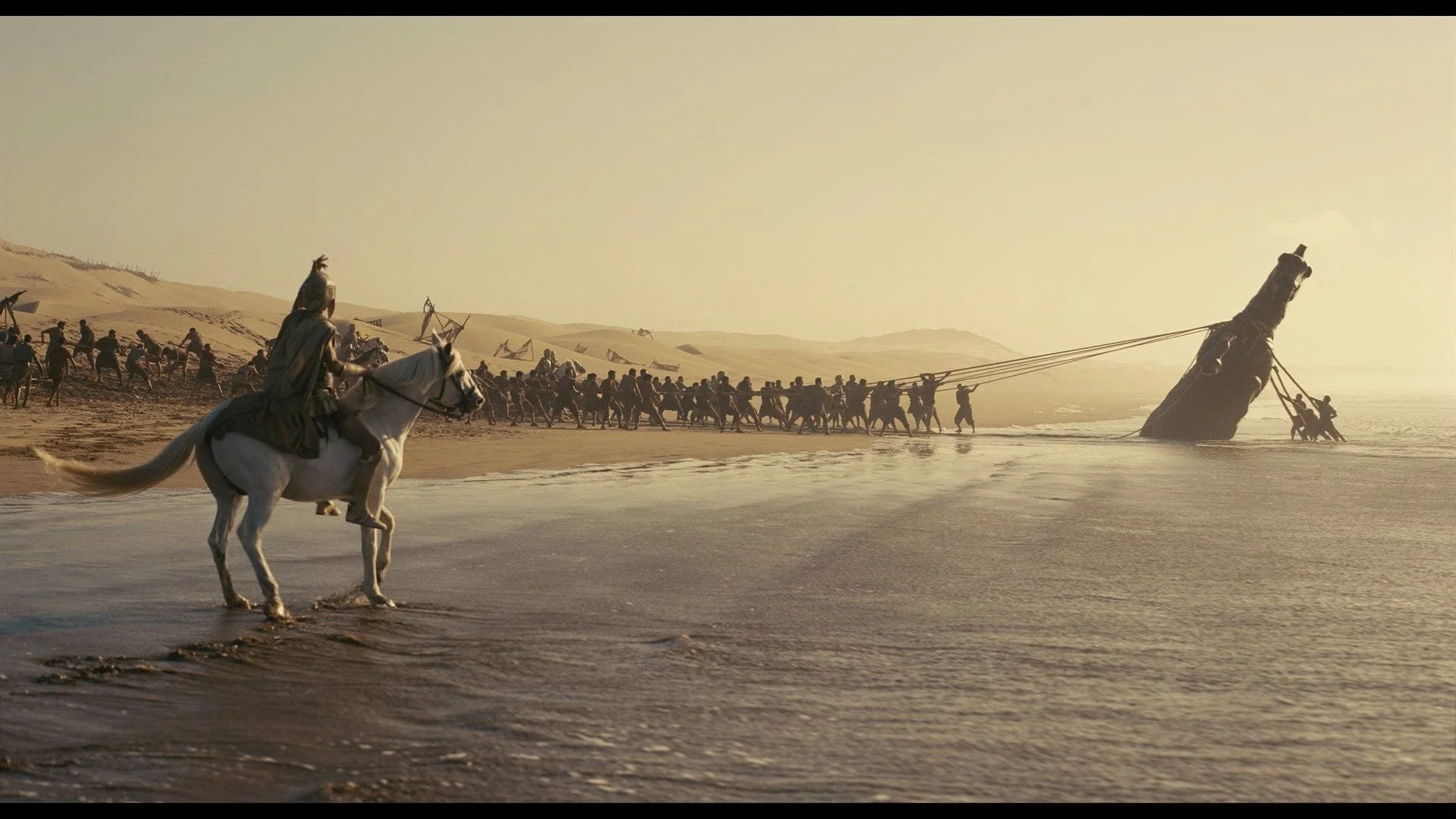
Francois Truffet once said that he only wanted to see movies that demonstrate the love or pain of making cinema. The important word is “or” as it is so hard to do both. Whether a movie like Coppola’s Apocalypse Now or Herzog’s Aguirre: the Wrath of God which demonstrate the pain of making a film or the more joyous examples of Guillermo Del Toro’s Pacific Rim or Spielberg’s ET, it is the palpable joy and pain of making those films that is visceral while watching it. When watching Nolan’s Odyssey, you can’t help but feel the pain of sitting in the Trojan horse, or the locations that must have taken forever to get to every day, or the coldness of the water and rain. But you also feel the joy of a director making the film they want to make. Using IMAX cameras in a way that no one ever has. You feel the camaraderie and family formed by the cast. You feel everyone’s love for each other. Being able to achieve both the feelings of love and pain for cinema, Nolan’s The Odyssey is a love poem to movies itself.